

4·
5 months agoYeah, I chose it since it’s at least local-only. Much higher doubt Apple can ever take that integration from me - and if they do, I can just stay on a Home Assistant version that doesn’t.
Yeah, I chose it since it’s at least local-only. Much higher doubt Apple can ever take that integration from me - and if they do, I can just stay on a Home Assistant version that doesn’t.
I swapped from Nest to Ecobee. Working in Home Assistant via HomeKit entirely on my local net. All is well. Thanks Google!
Recently was given an Ecobee smart thermostat. Ecobee does not have a great integration for Home Assistant, but Home Assistant can act like an Apple HomeKit hub, and if you provision the smart thermostat through that, it is entirely local.
I think you gotta use the app to provision and then turn on the RTSP or ONVINF settings in there, then once you have the IP address, you just add the RTSP stream to Frigate
I use Reolink front door camera with RTSP (thru Frigate) to HA if that’s at all interesting

I mean preppers try to be as self sufficient as they can. Hosting your own stuff is similar to that, so yeah, I guess.
My outage was when the internet to my house was intermittent, not when AWS went down
I’ve been using a Reolink Wi-Fi doorbell connected to my own Frigate server over RTSP. Frigate talks to HA via MQTT and everything works from there.

Competition has grown in the industry and long-term live-service black hole games have captured parts of the potential purchase-base so wholly that they don’t really spend elsewhere.
Game companies have plenty of methods for bringing costs down, but making games faster gives you more attempts at a very competitive market. (Some) Indie games are sort of proving this right. If you make a relatively quality game in a short time period and release it for a relatively good price, you can get your foot in the door of the market. If you spend 5+ years making the biggest game you’ve ever made and it sucks, your studio dies.
The big question is if AAA shifts to making games faster, are they going to be of a high enough quality to justify the outrageous price publishers will still want to set for them? (easy: no)
Basically I see it as the industry splitting even further. The AAA games that make money will continue to do so only so long as their last game lets them float 5+ year dev cycles. Otherwise, companies and publishers are going to reduce risk and investment and push developers to make their game faster, get to market faster. Arguably that would be healthy for the industry, but I know it won’t be.
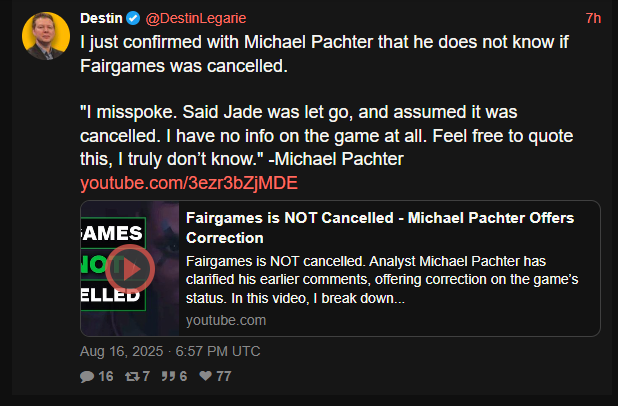
Apparently not canceled
Possible, but I think that particular feature is more aimed at EU electrical prices.
Fix would be government regulation.
Alternatives are sending cash by mail, accepting bank ACH, and of course, cryptocurrency.

Technically just a neural net, but yes
BYD uses lidar, so yeah, Tesla

I’d argue the same, actually. It takes people to moderate people and dedicated servers make it easiest. Modern match made games could still have admins, the company needs to pay for them.
Depends on the game, really, but “relying” on anti-cheat is pretty common. Larger games tend to have teams who review cases that get flagged by the systems and players and do manual removal but these teams also tend to be quite small and unable to adequately handle the amount of cheating that occurs.
If gamers want to see cheaters less often, they need to pressure the companies to do human moderation in addition.
JPEG-XL is only really in limbo because Google chose to kill it in Chrome in favor of AVIF. Had that not happened, there would have been far more demand for it to be properly implemented everywhere. Sucks, but you’re right that we’ll have to stick with AVIF/HEIG/WebP.
I said in a previous article that this is great, but we should be adopting JPEG-XL as it is current and can now compress pixel-perfect / lossless images better than old PNG. IIRC this revision of the spec doesn’t improve compression yet but it’s coming.
Also a lot of old proprietary game engines were written either specifically for DirectX or additionally for DirectX because in the olden times it was the most advanced and compatible rendering software.
Then, those developers move forward in time to work on other engines and focus primarily on DirectX because it’s still good, compatible, and it’s what they know best. OpenGL languished and it took a while for Vulkan to come out, catch up, and standardize their API.

That is what my analogy suggests and I suppose how you define wealthy matters, but that’s not strictly what I mean. I just mean prices are starting to striate.
AAA game devs are spending more on games every year and then suddenly finding out their market isn’t as wide as they hoped. High upfront cost + low demand sounds like a luxury product then, no? In the before times, they would release for $60 and squeeze hard for money. They can still do that, but now - since the price dam has broken - they can release for $80-100 and get more cash per super fan and then drop price aggressively to catch others who balked at the initial price.
I’ll be clear that the problem is the AAA industry spending too much on games when they don’t need to.
Good.