That is the same kind of pedantry as claiming that ketchup is a smoothie because the tomato is a fruit.
I take my shitposts very seriously.
- 11 Posts
- 996 Comments
Joined 3 years ago
Cake day: June 24th, 2023
You are not logged in. If you use a Fediverse account that is able to follow users, you can follow this user.
Why do hikers travel to different mountains to conquer?

 15·4 days ago
Neovim with Nvchad is what finally made me ditch pretty much all other IDEs. As much as I used to like Jetbrains, they’ve pivoted to vibe coding so hard that I can’t justify using their IDEs.
Truth, my ass. I’ve read your recent comments. You’re just being a self-righteous dickhead with a false sense of superiority. You derive your self-worth from being a contrarian.
 3·8 days ago
You should also look at which processes use the largest amount of memory. ZFS is weird and might allocate its cache memory as “used” instead of “cached”. See here to set its limits: https://forum.proxmox.com/threads/limit-zfs-memory.140803/
The most useful is probably
cat /proc/meminfo. The first couple of lines tell you everything you need to know.MemTotalis the total useful memory.MemFreeis how much memory is not used by anything.Cachedis memory used by various caches,e.g. ZFS. This memory can be reallocated.MemAvailableis how much memory can be allocated, i.e.MemFree + Cached.
Some people, for reasons I can only speculate on, don’t like speaking in first person singular. In most cases that I’ve seen, they use “we”. I don’t necessarily agree with the practice from a linguistic perspective, the English language is already a garbage fire as it is without introducing more ambivalent speech… but then I also want to go back to using “thou” for second person singular, so I’m probably not qualified to speak on the matter.
Even if Galaxy is running under Wine:
- It’s a package manager. It handles downloading files and updates, installation and patching, and verification.
- It integrates various GOG services, like cloud storage for save files.
- It can set environment variables and pass arguments to launched games.
Besides, a Linux-native port doesn’t need to package anything. It can simply mark Wine/Proton and various compatibility solutions as dependencies. Lutris, for example, is still a great utility even if it doesn’t use the packaged Wine versions: all it really needs to do is execute some program in the correct runtime environment with the correct arguments.
If you open the GOG website inside Heroic, it acts as an affiliate link and the HGL team gets a revenue split. An official partnership would still be better, but it’s something.
(edit) Further details here: https://www.gog.com/forum/general/support_heroic_launcher/page1
And Heroic’s GOG affiliate link: https://heroicgameslauncher.com/donate (it uses Adtraction and might trigger some ad blockers)
Two-day suspension.
“Everything is a file” means that many of the system’s components are represented as abstractions in the filesystem. It’s simply an API that allows reading from and writing to it by integrating into the hierarchical file structure.
If you take a look inside
/sys, you will find a fuckton of files, but they don’t represent data stored on a mass storage medium. Instead, the directory contains a mountedsysfsfilesystem that contains file-like representations of various parts and properties of the system. For example, you can read them like a file by runningcat /sys/block/sda/queue/rotationalto check if thesdablock device is a spinning disk (1) or solid-state storage (0). Or you can write to them like a file by runningecho 1 > /sys/block/sda/devices/deleteto commandsda’s driver to detach the device. Similarly,/proccontains a mountedprocfsfilesystem that presents information about running processes as file-like entries;/devcontains a mounteddevfsthat points to various devices; and/tmpand/runcontaintmpfsmounts for temporary storage in volatile memory (RAM or swap).Windows uses various other APIs (like the Component Object Model and others) to accomplish the same that are not necessarily tied into the filesystem.
It follows the same convention as most programming languages that expose the argument list. Python’s
sys.argvhas the program name at index 0 and the first argument at index 1. C’schar **argvdoes the same: index 0 is the program name, index 1 is the first argument. So it stands to reason that Zsh’s$0should be the program name and$1should be the first argument……which, by the way, is exactly what Bash does as well.
One day time-out. Both of you. If you want to toss shit at each other, take it to Twitter.
That isn’t incorrect, but it’s not as important as people make it out to be. Linux isn’t certified as POSIX-conformant either.
People are way too stuck on POSIX regarding Fish specifically, but in shell scripting, POSIX compliance boils down to “can it run a pure
shscript”. Bash is compliant. Zsh is partially compliant and needs to set an option to emulatesh. Fish uses a different syntax and is not compliant; if that is a problem, don’t executeshscripts in Fish.POSIX compliance for shell scripts was important in the 80s and 90s when the
#!directive wasn’t as commonly implemented and every script might be executed by the user’s$SHELLinstead. That is no longer the case as virtually every Unix-like system’s program loader supports#!.
It’s every person’s responsibility to make sure their mom’s (or dad’s (or other parental figure’s)) vibrator runs only secure, trusted software!
My heart bleeds for you, you poor oppressed victim of systemic injustice.







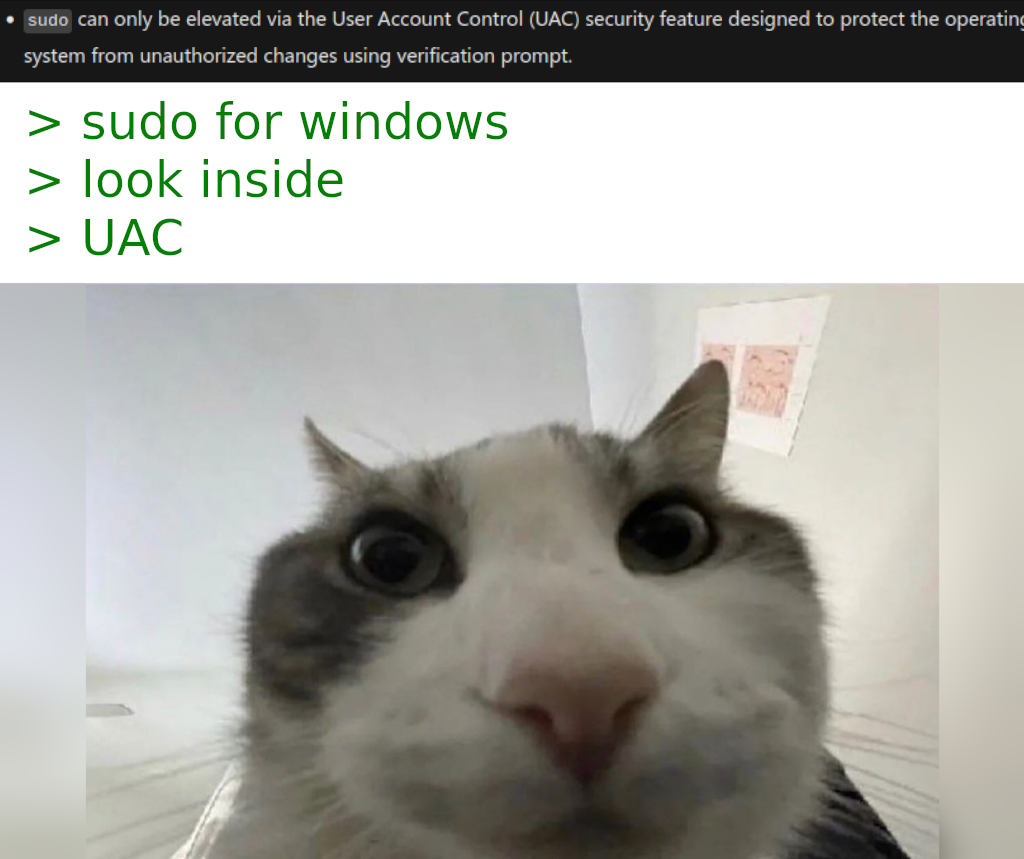


This same image was posted 16 hours ago.
Unless this is some kind of meta-meme that draws parallels with repetitively using the same commands in CLI.